Adverse Driving Conditions
Posted on October 18, 2012
Filed Under HOURS OF SERVICE
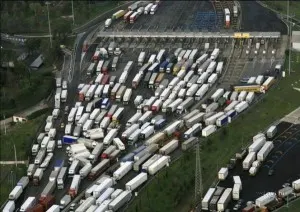 Here’s a topic which every over the road driver seems to know: adverse driving conditions. 49 CFR 395.1(b)(1) states that a driver may run 2 hours over his 11 and 14 hour limits to complete his run if he encounters adverse driving conditions.
Well, what does that mean? “Adverse driving conditions” is defined in 49 CFR 395.2 as “snow, sleet, fog, other adverse weather conditions, a highway covered with snow or ice, or unusual road and traffic conditions, none of which were apparent on the basis of information known to the person dispatching the run at the time it was begun.”
Most DOT people try to limit or ignore this section of the rules. Nevertheless, it is still in the rules, and it still does apply. DOT focuses on the part “none of which were apparent on the basis of information known to the person dispatching the run”.
In other words, if AccuWeather has been calling for snow to start falling in mid-afternoon, and my run is scheduled to end at 6pm, then the arrival of snow would not meet the definition of “adverse driving conditions”. Yeah, it’s adverse, but no, it was not unknown at the time of dispatch.
The part about unusual road and traffic conditions is also pretty vague. To a DOT guy, this means if you get stuck in a 2 or 3 hour traffic jam in Newark at rush hour, that is not unusual, and therefore, you do not get to claim adverse driving conditions. To me, that would be unusual. Yes, traffic is heavy in the Northeast at certain times of the day, but if what normally takes 2 hours, takes 4 or 5 hours today because of an accident, then it’s unusual.
Another part of this exception is the part about completing your run. This is undefined, but to me, it means if you were supposed to make it back to the yard by the end of the day, and within your normal hours of service, but cannot due to “adverse driving conditions”, then you get the additional 2 hours. Or, if you were going to make it to the receiver by the end of your shift, then you get the additional 2 hours.
Where I do not think it applies is if you were not going to deliver or be at the yard by the end of the shift. For example, if I am on a multi-day run from Pennsylvania to California, and in Missouri, I encounter adverse driving conditions, which prevent me from making it that night to my favorite truckstop, with the really good, all-you-can eat buffet. I do not believe the exception allows me to drive the extra 2 hours, because the AYCE buffet is not the end of my run…. California is.
Another twist to the exception is, it only applies to the 11 and 14 hour rules. It does not apply to the 70 hour rule. If your 70 hour clock runs out while sitting in a massive traffic jam, you do not get another 2 hours to extend your 70 hour clock.
If a driver wants to use this exception, I recommend noting the adverse driving conditions in the comments section of the log. Otherwise, it’s going to look like an hours of service violation. What happens if you get stopped at a scale at your 15th hour, after finally clearing that 3 hour traffic jam caused by an accident? Be prepared to explain what adverse driving conditions mean, where the adverse driving conditions were, where you are going, when you normally would have gotten there, etc., etc. As I pointed out, the definitions of these terms is somewhat vague, and DOT cops want to draw it as narrowly as possible.
With the advent of the black boxes, I predict this section of the rules will see a big comeback in the coming years. I thoroughly expect DOT to limit it through more careful interpretation, or eliminate it altogether, as it is incompatible with their new “zero-tolerance” attitude for violations.
Comments
Leave a Reply

-
ERIC'S USDOT COMPLIANCE GUIDE
Vehicle Sizes & Weights Manual
CMV Driver Basics (DVD/VHS)
Hours of Service Guide (DVD/VHS)
OSHA For Transportation Manual
Dry Van Cargo Securement DVD
Flatbed Cargo Securement DVD