Truck Drivers Replaced by Self-Driving Trucks?
 I ran across this blog this morning about self-driving trucks, and the elimination of truck drivers. It is thought provoking. At this point in my life, I like anything which makes me think, which eliminates 98% of all TV shows. The author’s premise is that self-driving trucks will hit the roads in the next 10 years, and shortly thereafter, will replace all truck drivers. Furthermore, he points out that truck driving, and the people who support and assist the trucking industry (like me, I guess), are all going be unemployed, and how are we going to deal all these unemployed people? I think his conclusion is that all the unemployed truck drivers, as well as everyone else, needs to be given a basic income.
I probably do not agree with him about the basic income part, as he does not say where that’s coming from… I assume it’s coming from everyone else who has a job. Furthermore, don’t we already do that, in the form of welfare, job re-training programs, etc.?
As far as the self-driving trucks goes, that is the thought-provoking part. This technology is definitely coming, and the blog does a good job of laying out some basic details and timelines. He quotes Morgan Stanley, a too-big-to-fail investment bank, which guesses that by 2022, a completely self-driving car and truck will be here. It further guesses that in 2026 these vehicles will start replacing the self-driving vehicles, and by 2046, self-driving vehicles will be gone.
The blog author is correct in stating that self-driving vehicles will happen faster for trucks than cars. For one thing, I’m not giving up my self-driving car. Of course, by 2046, I’ll be 78 years old, and I may desire the convenience and security of a self-driving car, as I won’t be able to keep up with all the young whippersnappers zooming by me. Probably not, I really hate the idea of being driven by a self-driving car.
Self-driving trucks, though, will be incredibly popular. There is just no way a human-driven truck can complete with a computer-driven truck. Compared to a human truck driver, the computer truck will be much cheaper to operate, possibly many times cheaper. Furthermore, the computer truck can just keep running, stopping only for fuel and maintenance. No more running out of hours. I believe that truck drivers will still be needed, but in only a fraction of the numbers we have today. The driver would basically exist as a computer repair technician, mechanic, and driver, all rolled into one. Whenever a computer truck breaks, you would call out the repair technician/driver to rescue the load.
One unknown is how safe these vehicles will be. Everyone in the technology sector assumes they will be much safer than human-driven trucks. I’m not so sure. How often will the computer break? I have a computer, and it breaks all the time. It freezes, locks up, drops the wireless signal, does little inexplicable things, which I then have to fix. When these sort of things happen in the computer truck, what will happen? The blogger says these trucks are designed to slow down, and pull off the road when they computer senses it needs help. Well, we’ll see, I’m not so sure.
Also, I don’t know how forgiving the public at large will be when a computer truck has a wreck. It is definitely going to happen; as I said computers break all the time. When a human truck rear-ends a line of cars and kills 4, we put the driver in jail, and sue the trucking company. When a computer truck does that, who are we going to put in jail? Are we going to sue Apple? I guess it will basically come down to how often it happens. If it happens one tenth as often as the human trucks crash, we’ll probably just mark it up to “nothing’s perfect”, and accept it, because the number of lives saved over human trucks will be undeniable.
I believe these timelines are probably way optimistic. Everything always takes twice as long as you think it’s going to take. I have no empirical evidence to support that. It’s just something I have observed. For example, look at movies which speculate about future technologies. In “Back to the Future II”, which was set in 2015, they had flying cars, and Mr. Fusion, which generated 1.21 gigawatts of power from banana peels and beer. I just checked outside my front door, and in my 2015, I see neither.
Someday, truck drivers will be largely eliminated, but I think this will not start to happen until 2030, at the earliest. Who knows, maybe they will invent a Star Trek-type transporter first, which will eliminate the need for all types of trucks, computer-driven, or otherwise.
Guilty Until Proven Innocent
Sometimes I go months without posting anything on the website. Then there are others, when I am particularly annoyed, where I can’t wait to post things. I ran across an article in the Atlantic this week, which I believe is very important. It is about a topic which I have been upset about for years, called civil asset forfeiture.
Civil asset forfeiture is a procedure where a police agency, whether it be a Federal, State, or local police agency believes you are guilty of a crime. They seize whatever assets they believe may have been generated from this crime(s). It is meant to be a tool in the War on Drugs, or the War on Organized Crime, or whatever. The individual who had his assets seized must then go to court and prove his innocence to get his property back.
Without question, civil asset forfeiture has resulted in the police seizing large amounts of cash and property from criminals. Also, without question, it has resulted in the police seizing the same from totally innocent persons. I do not know what the “guilty vs. innocent” ratio is, but there is no doubt that innocent people are having their assets seized, without warrant, without proof, and without ever being charged with a crime.
Many times, you do not have to be the one who did the crime, or even to have had knowledge of the crime. In Philadelphia, there was a notorious case where a couple lost their house because their son sold $40 worth of heroin to an undercover police officer without their knowledge.
In the Atlantic article, it describes how Amtrak trains are favorite targets of the police, who board the train questioning “suspicious” passengers, and forcibly searching their luggage. Any cash discovered is confiscated, on the theory that it was probably generated by illegal activity such as drug dealing.
How can this happen in America, you ask? Wake up, man. This is not your father’s America, or the America you watched on Dragnet re-runs. The ends justify the means, and the Constitution is just some old piece of paper no one has ever read, or cares about.
Of course, we in the trucking industry have dealt with this kind of “ends justify the means” mentality for years from the FMCSA. When FMCSA audits you, the audit results are gospel. If you appeal the results of your audit, with respect to your safety rating, you must prove your innocence. FMCSA assumes the audit is correct, and the burden of proof is on YOU, regardless of what you saw on Dragnet re-runs.
Anything on that audit is immediately splashed onto their CSA website for the entire world to see, in the form of their scarlet triangle with the ! in the middle. What if they made a mistake? What if you’re not guilty? Doesn’t matter, it still goes up on the website until you can prove your innocence.
Then don’t forget the entire DataQ, due process sham, which itself deserves a 1,000 word post.
This governmental behavior is outrageous, and is not what our government should be doing. If the government is going to deprive you of your property, or your freedom, the government should always have to prove why that is necessary. When we start allowing the government to take short-cuts, just because it’s more efficient, easy, and convenient, then we are merrily marching on the road to a police state. We may already be there.
As I have stated in previous posts, I am building a Manifesto for a New FMCSA, one where the rights of the regulated are respected, and accident reduction is more important than blind adherence to scores of regulations. I am still working on the name. I intend to circulate my Manifesto to all the Presidential candidates, where I think it may be taken seriously. For example, Ted Cruz, Rand Paul, Scott Walker, Hillary Clinton, etc. Ok, I threw that last one in there as a joke.
My previous Directives were:
1. Fire half of the FMCSA staff.
2. Consider preventability of accidents in the CSA system.
Directive #3 of my Manifesto will be to put the burden of proof in any matter where the FMCSA is taking enforcement action against a person or motor carrier on the FMCSA. No more slipshod, “we all know you’re guilty, so we don’t need to prove it” nonsense. We will spend a few extra dollars so the agency may enforce the regulations fairly, and provide due process to the regulated motor carriers. I will get these extra dollars from the money we saved by firing half of the FMCSA staff.
Lac-Megantic: The Biggest Transportation Disaster You’ve Never Heard Of

At approximately 1:00am on July 6, 2013, an unattended train loaded with flammable crude oil was parked on a hill near Nantes, Quebec. The train was not properly secured, and it began to roll downhill. At 1:15am, it smashed into the town of Lac-Megantic, Quebec, going approximately 65 mph. It derailed and exploded, ultimately killing 47 people.
What does this have to do with trucks? Nothing, although it does involve trains, trucking’s distant cousin, and I like trains. I do think there are some lessons to be learned, which do apply to trucking. I think it’s a powerful story, of which you have probably never heard, because it happened 20 miles on the other side of the border in Canada.
I’m going to summarize how a train with 63 oil tankers managed to runaway, derail, and explode. Before I get too far, though, below is an audio recording of a phone call between the engineer of the train, Tom Harding, who was supposed to have secured the train so it didn’t run away, and his dispatcher which occurred at 3:29am, about 2 1/4 hours after the train exploded. Harding is in Lac-Megantic at this point, as that’s where his hotel was. He knows the town is on fire, he knows there are oil tank cars burning. He has not, somehow, figured out it is his train which escaped and exploded. Go to 00:55 of the phone call, and hear how someone reacts when informed they just killed 47 people. Beware: the recording contains, not surprisingly, profanity.
The Train
The train was operated by the now bankrupt Montreal, Maine, & Atlantic Railway (MM & A). It originated in North Dakota, and was heading east for the Irving Oil refinery at St. John’s, New Brunswick. It had been operated over a number of railroads, and was now being moved over the MM& A, at the time of the accident.
Here is the route the train took leading up to the accident.

Apparently, on the MM & A, it is standard operating procedure to operate a train with just one employee; the engineer. There is no caboose, there is no conductor, it’s just one guy in the lead engine. That was the case on the night of the accident. Engineer Tom Harding had driven the train from Farnham, Quebec to Nantes, Quebec, where his shift expired. Harding parked the train on a descending grade on the main track about 22:50 on July 5.
Here is a picture of the train, taken on July 5, before the accident.
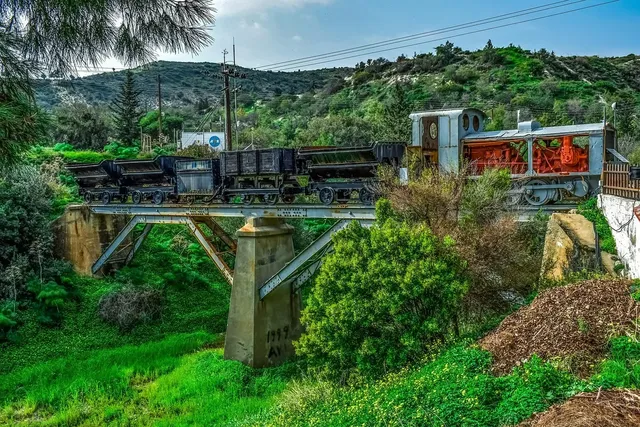
Once at Nantes, which is about 6 miles west of Lac-Megantic, Harding normally shuts the train down, except for the lead engine, applies the brakes, and then calls a taxi, which takes him down the hill into Lac-Megantic, where he stays at a hotel. Then in the morning, another engineer picks up the train and continues east, while Harding catches a westbound train.
On this night, Harding set the hand brakes on the 5 locomotives, a buffer car, which was a caboose, and the first car, which was a boxcar: seven units in all (five locomotives, one caboose, and one boxcar). He also left the lead engine running, which kept its independent airbrake applied. The lead engine was emitting heavy smoke from its smokestack, however, Harding and his dispatcher decided to let the engine run, expecting the smoke to dissipate as it idled. At around 23:30, Harding got in a taxi, and traveled 6 miles down the hill to his hotel in Lac Megantic.
Just ten minutes later, at 23:40, a 911 call was made to the report a fire on the train. The lead engine had caught on fire.
MM & A sent a track foreman to meet the local fire department. Upon his arrival, the fire department had already shut off the engine, and flipped the electrical breakers to the off position in the cab. At 23:59, the Farnham dispatcher called Harding at his hotel in Lac Megantic, and informed him of the fire. The dispatcher, named RJ, tells Harding the lead engine, which was left running, 5017, caught on fire. He tells him it was shut off. Harding asks if he needs to go back to the train, and start another engine, and the dispatcher tells him, that’s not necessary, and that they’ll start the train back up in the morning. Harding accepts this, hangs up, and goes to bed.
Here is the audio of that phone call, which actually begins at 00:42.
With the engines dead, there was no air compressor running to supply air to the air brake system. Air began to slowly leak from the system, weakening the lead locomotive’s independent brake. About an hour later, around 01:00 on July 6, the braking force of the seven (7) hand brakes and the fading independent brakes proved insufficient to hold the train in place. The train began to roll down the hill. The grade on the track leading into Lac Megantic is around 1%. While that may seem very gentle, given the weight of the train, it was more than enough. By the time the unmanned train hit town, at 01:15, it was moving at 65 miles per hour.
There is a curve in the center of town, with an assigned 15 mph speed limit. The engines managed to get through the curve, and continued down the track. The tank cars however, being top-heavy with flammable crude oil, could not make the curve at 65 mph, and begin flipping over. As they piled into one another, they ruptured, and ignited. Rapidly, the center of town turned into an inferno, burning 47 people to death.
At 01:47, Harding has been rousted out of bed at the hotel by the explosions, and calls his dispatcher “RJ”. Harding informs the dispatcher Lac Megantic is totally on fire at this point. However, he is clueless that it’s his train which ran away and blew up. RJ, the dispatcher, isn’t sure what’s happening either, although I have read that by this point, he had been getting some calls that it was Harding’s train which rolled from Nantes into Lac Megantic. Harding assures him the train is still at Nantes. Of course, it was not. Here is that audio, more profanity:
At 03:29, Harding calls the dispatcher RJ again. At this point, it has become painfully clear to RJ and the rest of the Train Operations Center in Farnham that it was Harding’s MM & A train which got loose and exploded. Harding is still somehow in the dark. RJ tells Harding it is his train which is burning in the center of town. Here is that phone call again:
If you want to read the transcripts of all these phone calls, here is a link to a The Globe and Mail story, where they are all detailed.
Aftermath
The President of MM & A, Ed Burkhardt, almost immediately blamed Harding, stating he did not apply enough handbrakes on the train. After several months, in May, 2014, Canadian authorities arrested the engineer Tom Harding, as well as traffic controller Richard Labrie, and manager of train operations Jean Demaitre, charging them each with 47 counts of criminal negligence. I have tried for figure out if Richard Labrie is the “RJ” from the audio tapes on the night of the crash. I believe it must be, but I don’t know for sure.
TSB Report
In August, 2014, the Canadian TSB, which is their NTSB, released their final report, which I have used as a source for much of this story. It confirmed that Harding did not apply enough handbrakes to hold the train. It also asserted the cause of the engine fire was due to a substandard repair on a cylinder in the engine, which allowed oil to leak and burn. The TSB alleged the MM & A did not take safety seriously. I agree with the TSB.
Analysis
I know a little about railroading. That’s to say, I probably know more than most, but certainly not as much as people who actually work for railroads. I read some pretty good analysis on a railroading forum regarding this accident. It is a standard railroading axiom that you never trust airbrakes alone to secure a train. In other words, you must assume the airbrakes will fail, and there must be enough mechanical handbrakes applied to hold the train. Harding did not apply nearly enough handbrakes. Normally, the airbrakes on the running engine holds the train; no problem. This time, though, the holes in the cheese lined up. The engine broke. It broke while Harding wasn’t there. No one started another engine. Harding was in the habit of not applying enough handbrakes. No one ever trained him, or disciplined him to apply more.
When Harding talked to the dispatcher RJ at midnight, he offered to go back up to the train. The dispatcher RJ told him, don’t worry about it, get his break, take care of it in the morning. The dispatcher probably assumed the train was tied down with enough handbrakes. Harding didn’t figure out at that point, or really at any point, that with lead engine 5017 shut down, only the handbrakes would be holding the train.
There’s an interesting article here, which says once Harding, Labrie, and Demaitre were arrested, they were arraigned in Lac Megantic. Rather than being lynched, the crowd was very quiet; almost sympathetic, largely because they wanted MM & A President Ed Burkhardt, not his three underlings. I’m not totally sure what role Labrie, Demaitre, or even Burkhardt played yet. As for Harding? I know he’s just a regular guy, and by all accounts an experienced engineer. I’m sure he’s been destroyed by the accident. But damn man, you royally screwed up. If it was one of my family members who burned to death? I’m not so sure I’d be so sympathetic.
One thread I see in this accident which carries over to trucking is complacency. Sometimes truck drivers, bus drivers, or in this case, a railroad engineer, forget how dangerous their job can be to themselves and others. In this case, complacency certainly extended up the ladder all the way to the top levels of the MM & A management, who obviously did not take safety seriously enough. I am sure Harding, and probably numerous other MM & A engineers, had parked their oil trains at that exact stop, and had secured the train in that exact way hundreds, if not thousands of times over the years, without incident. This time, though, it all went bad. The bottomline is Harding did not have enough handbrakes applied, and relied on a malfunctioning engine to hold the brakes in place. The brakes failed, and disaster ensued.
This story is mostly told at this point. It’s been almost two years since the accident. The dead have been buried, the town has been mostly rebuilt. The TSB has issued its extensive report on the facts surrounding the case. MM & A went bankrupt.
All that remains is the assignment of blame. Harding and his two MM & A co-workers have been criminally charged with a host of crimes. The Canadian government has elected not to charge anyone else at MM & A with a crime, despite the fact that the TSB discovered a substandard repair on the lead engine is what probably caused it to catch fire in the first place.
Whether Harding and his cohorts are convicted is an open question at this point. While Harding is not 100% responsible for this disaster, he is definitely partially responsible. Whether that will equate to a conviction remains to be seen. Take heed from this disaster story. Sometimes the worse-case scenario does happen.
DOT Inspector General to “Audit” FMCSA
 Apparently, the Department of Transportation Inspector General (IG) is going to “audit” FMCSA. They are doing so, in an effort to ascertain why FMCSA is not being tougher on motor carriers. Hahahahahahahahahahaha!!!! You read that right.
At the behest of Dick Durbin, Senator from Illinois, the IG will begin “auditing” FMCSA. Durbin demanded an inquiry after DND International, of Naperville, IL was involved in a fatal accident in January, 2014, where a tollway worker was killed, and a State Trooper was injured. I wrote about the DND case here.
In a nutshell, after the accident, FMCSA commenced a six week long audit, at the conclusion of which, they pulled DND’s operating authority, declaring DND was an “imminent hazard”. DND’s esteemed attorney, Dave Laporte, Esq. successfully argued DND was not an imminent hazard, and had their authority restored. However, despite the fact that an Administrative Law Judge ordered DND operating authority restored, DND lost all its customers, and probably could not get insurance. Presently, they appear to be inactive. In other words, they won the battle, but lost the war.
Now, Senator Durbin wants FMCSA to enforce the rules even more strictly. He is going to have the IG torture FMCSA with the cushions and the comfy chair. This ‘audit’ will be a lovefest, as the people calling the shots at FMCSA would love to beat the industry longer, harder, and with more frequency. This IG audit will help them do that.
The fact is, there are hundreds, if not thousands, of motor carriers out there with DND’s identical compliance record. As we all know, FMCSA’s religion is the CSA, which has a very, very tenuous link to safety and crashes… if any. I imagine, if Senator Durbin has his way, FMCSA can just pull the authority of any carrier with a CSA score over 90. Or, any carrier which has an at-fault fatality. It won’t save any lives, and will probably cost lives, but at least the Senator will have a soundbite for the press.
